- 0
- 1
- 2
- 3
- 4
- 5
- 6
- 7
- 8
- 9
- 0
- 1
- 2
- 3
- 4
- 5
- 6
- 7
- 8
- 9
- January
- February
- March
- April
- May
- June
- July
- August
- September
- October
- November
- December
- 0
- 1
- 2
- 3
- 4
- 5
- 6
- 7
- 8
- 9
- 0
- 1
- 2
- 3
- 4
- 5
- 6
- 7
- 8
- 9
- 0
- 1
- 2
- 3
- 4
- 5
- 6
- 7
- 8
- 9
- 0
- 1
- 2
- 3
- 4
- 5
- 6
- 7
- 8
- 9
- Location
- Rotterdam, The Netherlands
- Age
- 22 Years
7th July 1945
We left for Rotterdam at 06:00 hours and arrived at the mouth of the river at about 16:00 hours. The river appears to be more like a canal, for both banks are smooth and straight and of course the water level is nearly the same as that of the land! The scenery for the 1800 odd miles up to Rotterdam was very similar to that of the Scheldt : green flat fields, tall trees, red-roofed (high pitched) buildings and windmills!
Once we had tied up, I got my bicycle out and cycled all around town. From the docks, the right hand side of the town has had a hammering. Only shells of blocks of flats remain for miles around. Many blocks are completely demolished. But elsewhere, I was very impressed by the orderliness of the layout, the almost immaculate layout of the buildings. Shop fronts all spring from one level (see below) and the multi varied gables of traditional Dutch architecture on the canals is being replaced by the one complete cornice level, perhaps only broken by a symmetrical nicking in the centre of the façade.
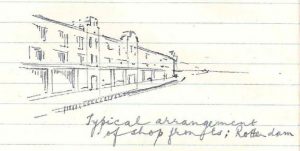
Streets are very wide and though cobble are better laid than Antwerp.
Amazing uniformity of design seems to be the keynote of the place and it will seem to be an architect’s dream city. The marvellous clay for the brickwork still plays a tremendous part in the success and colour of the city, as it has done all over Holland for years past. Some celebrations were going on in the side streets, for I saw flags of all nationalities, heard loudspeakers blurring for dance music, and crowds of people running various kinds of dances. etc. This seemed in contrast to the traditional stolid Dutch character, as reflected in the architecture.
The Gilder money, is of very little value and people don’t want them. They prefer something material in return, such as cigarettes or food. You can get a haircut and shave for three cigarettes or as much as, one pound for 20 cigs.